Best .40 S&W Ammo
Posted by Vizards Guns And Ammo on 7th Sep 2026
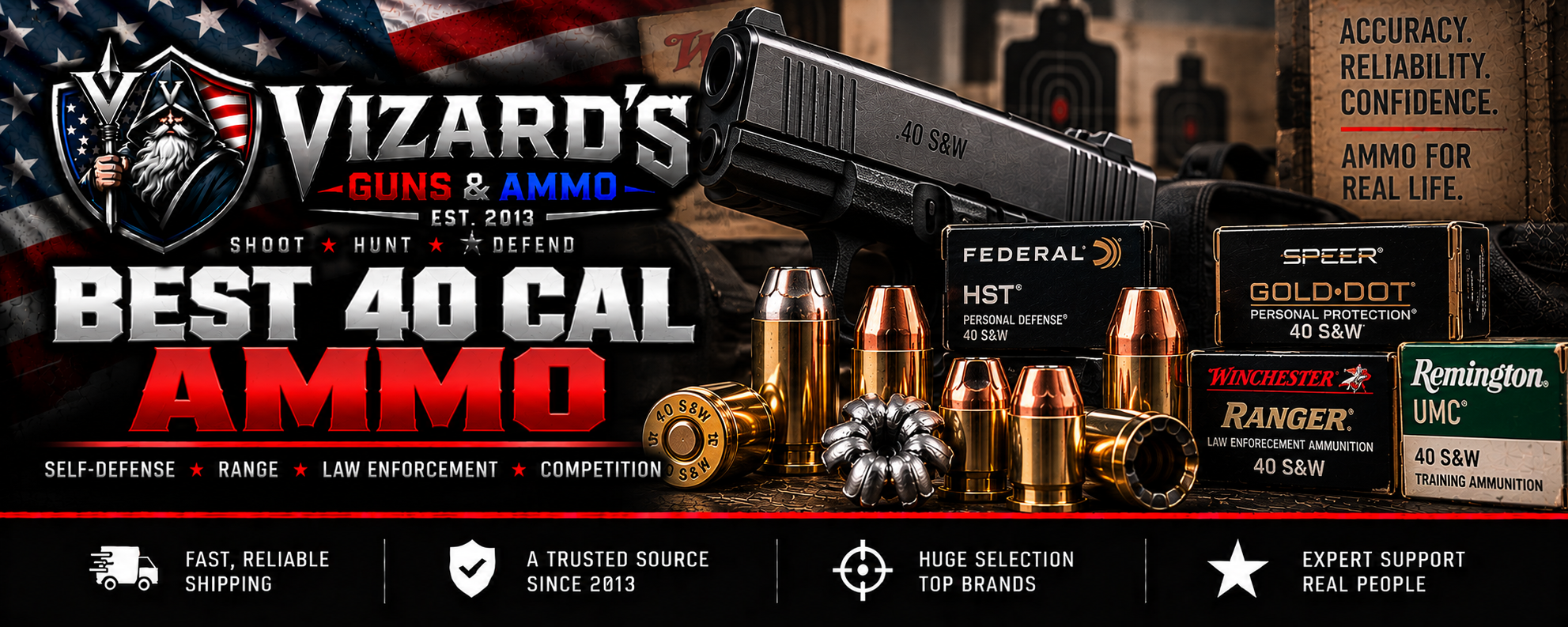
Best .40 Cal Ammo: Top .40 S&W Loads for Self-Defense & the Range
The .40 S&W may no longer dominate the law-enforcement handgun market the way it once did, but that doesn't mean the cartridge has disappeared. There are still millions of .40 caliber pistols in circulation, and ammunition manufacturers continue to offer everything from inexpensive FMJ practice ammunition to sophisticated defensive hollow points.
Choosing the best .40 cal ammo starts with deciding what you need the ammunition to do.
A load that makes sense for an afternoon at the range isn't necessarily what you want in a defensive pistol. Bullet weight matters too. The .40 S&W is commonly available with 155, 165 and 180 grain bullets, and each gives the cartridge a somewhat different feel and performance profile.
For shooters who already own a .40 S&W pistol, there are still plenty of excellent ammunition choices.
What Is .40 S&W Ammo?
The .40 Smith & Wesson cartridge was introduced in 1990 after law-enforcement interest in the performance of larger-caliber semiautomatic handgun cartridges increased during the late 1980s.
The story actually begins with the 10mm Auto.
The FBI evaluated 10mm ammunition and found that its potential was promising, but full-power commercial loads produced substantial recoil and muzzle blast. The Bureau subsequently explored reduced-velocity 10mm ammunition.
That created an opportunity for a shorter cartridge capable of providing similar performance from a more compact handgun platform.
The result was the .40 S&W.
It quickly became one of the most important American law-enforcement cartridges of the 1990s and 2000s.
Is .40 Cal the Same as .40 S&W?
Usually, yes.
When handgun shooters talk about ".40 cal ammo," they are generally referring to .40 Smith & Wesson, or .40 S&W.
But caliber alone isn't enough to determine ammunition compatibility.
For example, .40 S&W and 10mm Auto both use approximately .40 caliber bullets, but they are different cartridges with different case dimensions and operating characteristics.
Speer specifically warns against firing .40 S&W ammunition in a 10mm chamber because both cartridges headspace on the case mouth and the shorter .40 S&W case will not be properly supported for headspacing in a 10mm chamber.
Always use the exact cartridge specified by your firearm manufacturer.
155 Grain vs. 165 Grain vs. 180 Grain .40 S&W
One advantage of the .40 S&W is the variety of bullet weights available.
Three of the most familiar are 155, 165 and 180 grains.
155 Grain .40 S&W
A 155-grain bullet sits toward the lighter end of common .40 S&W ammunition.
Lighter bullets can generally be driven at higher velocities than heavier bullets in the same cartridge, although actual velocity depends on the specific ammunition and firearm.
Shooters who prefer a faster .40 caliber load may find 155-grain ammunition appealing.
165 Grain .40 S&W
The 165-grain bullet occupies a useful middle ground.
It provides more bullet weight than typical 155-grain ammunition without going all the way to the traditional 180-grain load.
Speer's current Gold Dot data, for example, lists a 165-grain .40 S&W Gold Dot load at 1,150 fps from a 4-inch test barrel.
Speer also developed a 165-grain Gold Dot CarryGun .40 S&W load specifically around performance from compact defensive pistols.
180 Grain .40 S&W
The 180-grain bullet is one of the classic .40 S&W weights.
Federal's published data for its 180-grain HST lists a muzzle velocity of 1,010 fps and muzzle energy of 408 foot-pounds from a 4-inch test barrel.
For shooters who prefer a heavier projectile and the traditional feel of .40 S&W, 180-grain ammunition remains one of the first options to consider.
There isn't one bullet weight that is automatically best for every pistol or every shooter.
The firearm, barrel length, ammunition design and intended use all matter.
Best .40 Cal Ammo for Self-Defense
Defensive ammunition is where bullet construction becomes especially important.
A quality jacketed hollow point is designed to provide controlled expansion while maintaining sufficient penetration.
You also want ammunition that functions reliably in your particular handgun.
Several established defensive .40 S&W loads deserve consideration.
Federal Premium HST 180 Grain
Federal HST is one of the first .40 S&W loads I would consider for a defensive handgun.
Federal's 180-grain .40 S&W HST uses the company's HST hollow-point design and is listed at 1,010 fps from a 4-inch test barrel.
The heavier 180-grain bullet also represents the traditional end of the .40 S&W spectrum.
For someone asking for a straightforward defensive .40 S&W load without trying to chase maximum velocity, the 180-grain HST is a very strong place to start.
Speer Gold Dot 165 Grain
Speer Gold Dot is another established defensive ammunition family.
Gold Dot bullets use Speer's Uni-Cor process, which bonds the jacket to the lead core. Speer says this construction virtually eliminates core-jacket separation, while the hollow-point cavity is tuned for the specific caliber and bullet weight.
The standard 165-grain .40 S&W Gold Dot is listed at 1,150 fps from a 4-inch barrel in Speer's published ballistic data.
This is a good option for shooters who want a somewhat lighter and faster defensive .40 S&W load.
Speer Gold Dot CarryGun 165 Grain
Barrel length matters with defensive ammunition.
A load engineered around a full-size duty pistol may not behave exactly the same way when fired from a much shorter barrel.
Speer addressed this directly with Gold Dot CarryGun.
The company says its CarryGun bullets were redesigned specifically for the reduced velocity potential of compact and subcompact pistols. The .40 S&W version uses a 165-grain projectile rather than the heavier 180-grain bullet used in its corresponding G2 duty ammunition.
If you're carrying a compact .40 S&W pistol, that makes this load particularly interesting.
Hornady Critical Duty 175 Grain FlexLock
Hornady Critical Duty approaches defensive ammunition from a somewhat different direction.
It is designed primarily around full-size handguns and performance through common intermediate barriers.
Hornady's FlexLock bullet combines a Flex Tip with an InterLock band intended to promote expansion, weight retention and penetration through the FBI's tactical handgun testing barriers.
The FBI awarded Hornady an ammunition agreement in 2017 for its .40 S&W 175-grain Critical Duty FlexLock load.
That doesn't automatically make Critical Duty the best choice for every civilian defensive pistol.
It does make it a historically important .40 S&W duty load with a design focused heavily on barrier performance.
Hornady also notes that Critical Duty is optimized around full-size handguns rather than short-barreled concealed-carry pistols.
So Which .40 S&W Defensive Load Should You Buy?
I wouldn't choose defensive ammunition based only on the brand name printed on the box.
Start with your handgun.
For a full-size .40 S&W pistol, Federal HST, Speer Gold Dot and Hornady Critical Duty are all reasonable premium ammunition families to evaluate.
For a compact or short-barreled .40, ammunition specifically engineered around reduced barrel length can be worth considering.
Then test the ammunition in your actual firearm.
Your defensive ammunition should feed, chamber, fire, extract and eject reliably in the pistol you intend to use.
Best .40 Cal Ammo for the Range
Range ammunition has a different job.
For routine practice, you generally don't need an expensive premium hollow point.
A quality FMJ or TMJ load makes much more sense.
Look for ammunition from established manufacturers that functions reliably in your pistol and gives you consistent practice without unnecessarily increasing the cost of every range session.
Common .40 S&W range ammunition is available from manufacturers such as Federal, Speer, Winchester, Remington, CCI Blazer, Fiocchi and Sellier & Bellot.
Price matters here because practice ammunition gets consumed quickly.
The more you shoot, the more meaningful a few dollars per box becomes.
165 Grain vs. 180 Grain for Range Training
If your defensive ammunition uses a 180-grain bullet, practicing with 180-grain FMJ ammunition can make sense.
It doesn't mean the two loads will feel identical.
Different manufacturers use different bullets, powders and velocities.
But matching the general bullet weight of your practice and defensive ammunition can give you a more consistent training setup.
The same idea applies if you carry a 165-grain defensive load.
You don't have to match bullet weight for every practice session, but it can be useful.
FMJ vs. JHP .40 S&W Ammo
This is one of the easiest distinctions to understand.
FMJ, or full metal jacket, ammunition is generally the practical choice for routine range training.
JHP, or jacketed hollow point, ammunition is generally the preferred category for defensive use because the bullet is engineered to expand under appropriate conditions.
Premium JHP ammunition costs considerably more than ordinary range ammunition.
That's why many shooters train primarily with FMJ and periodically shoot enough of their selected defensive ammunition to verify reliability and maintain familiarity with how it feels in their firearm.
Should You Practice With Your Defensive Ammo?
Yes, at least periodically.
Buying expensive defensive ammunition and loading it into a pistol without ever testing it isn't a great approach.
Different pistols can behave differently with different ammunition.
You want to know that your chosen load runs reliably in your firearm.
You also want to experience its recoil and point of impact.
You don't need to burn through premium defensive ammunition during every range trip.
Use less expensive ammunition for most training and periodically verify your defensive load.
Does Barrel Length Matter With .40 S&W?
Yes.
Published ammunition velocities are produced under particular testing conditions.
Change the barrel and you can change the result.
Speer's ballistic tables explicitly identify the test barrel used for each load and caution that individual firearms can vary.
This becomes especially important with compact defensive handguns.
Shorter barrels can reduce velocity compared with longer test barrels, which is one reason manufacturers have developed ammunition specifically for compact pistols.
For a deeper look at velocity, muzzle energy, trajectory and barrel length, see our .40 S&W Ballistics guide.
Is .40 S&W Still Good for Self-Defense?
The rise of modern 9mm ammunition changed the handgun market significantly, and many law-enforcement agencies moved away from .40 S&W.
That doesn't suddenly make a quality .40 S&W pistol ineffective.
A reliable firearm loaded with well-designed ammunition remains a capable defensive combination.
For people who already own and shoot .40 S&W pistols well, there isn't necessarily a compelling reason to abandon the cartridge simply because another caliber is currently more popular.
The more important questions are whether you can shoot the firearm accurately, control it during rapid fire and operate it reliably.
Is .40 S&W More Powerful Than 9mm?
This question is more complicated than simply comparing caliber diameter.
Specific loads need to be compared.
Bullet weight, velocity and bullet construction all influence performance.
The .40 S&W commonly launches heavier bullets than 9mm and can produce substantial muzzle energy, but that usually comes with increased recoil.
Modern 9mm pistols can also offer greater magazine capacity.
Those tradeoffs helped fuel decades of debate between the two cartridges.
Neither caliber makes marksmanship irrelevant.
What Is the Best .40 Cal Bullet Weight?
There isn't one answer for everyone.
155 grain ammunition generally appeals to shooters looking toward the lighter and faster side of the cartridge.
165 grain ammunition provides an excellent middle ground and is available in several serious defensive loads.
180 grain ammunition is the traditional heavyweight choice and remains extremely common in both defensive and practice ammunition.
Instead of choosing based only on the number printed on the box, consider the complete load and how it performs in your handgun.
How Much .40 Cal Ammo Should You Buy?
If you're testing a new defensive load, start small.
Buy enough to establish that the ammunition functions reliably and shoots well in your pistol before purchasing a large quantity.
Range ammunition is different.
Once you know a particular FMJ load works reliably, buying larger quantities can reduce the cost per round and make it easier to maintain a regular training schedule.
Keeping defensive and training ammunition separate also makes inventory management easier.
Choosing the Best .40 Cal Ammo
The best .40 S&W ammunition depends on what you're trying to accomplish.
For ordinary range practice, reliable FMJ ammunition at a competitive price is usually the priority.
For personal protection, bullet construction and reliable functioning become much more important.
Federal HST and Speer Gold Dot remain strong defensive choices. Hornady Critical Duty is particularly relevant for shooters interested in a heavier duty-oriented design and barrier performance.
Whatever you choose, test it in the firearm you actually intend to use.
A premium box and impressive specifications don't matter if the ammunition doesn't function reliably in your pistol.
Shop .40 S&W Ammo
Vizard's Guns & Ammo carries .40 S&W ammunition for range training, personal protection and other shooting applications.
Compare bullet weights, bullet types, brands, quantities and pricing to find the load that makes sense for your firearm and intended use.
Shop .40 S&W Ammo
Frequently Asked Questions About .40 Cal Ammo
What is the best .40 cal ammo for self-defense?
Federal HST, Speer Gold Dot and Hornady Critical Duty are established premium defensive ammunition families with .40 S&W offerings. The best choice depends on your handgun, barrel length and how the particular load functions in your firearm.
Is 165 or 180 grain .40 S&W better?
Neither is automatically better. A 165-grain load generally provides a middle ground between bullet weight and velocity, while 180-grain ammunition provides a heavier projectile and is one of the cartridge's traditional bullet weights.
What is the best .40 cal ammo for the range?
Reliable FMJ or TMJ ammunition from an established manufacturer is generally the most practical choice for routine range training. Premium defensive hollow points are considerably more expensive and aren't necessary for most practice.
Is .40 S&W still a good defensive caliber?
Yes. Although 9mm has regained much of the law-enforcement and civilian market, .40 S&W remains a capable defensive cartridge when paired with a reliable handgun and quality defensive ammunition.
Can I shoot .40 S&W in a 10mm pistol?
No, not unless the firearm manufacturer specifically provides a properly designed conversion setup. Speer warns that the shorter .40 S&W cartridge does not properly headspace in a standard 10mm chamber.
What are the most common .40 S&W bullet weights?
155, 165 and 180 grains are among the most familiar .40 S&W bullet weights, with 165 and 180 grain ammunition especially common.
Is hollow point or FMJ better for .40 S&W?
They serve different purposes. FMJ is generally appropriate for economical range training, while quality JHP ammunition is designed for defensive applications.
Does .40 S&W have more recoil than 9mm?
In comparable handguns, .40 S&W will generally produce more felt recoil than typical 9mm ammunition, although firearm weight, grip design, ammunition and the shooter all affect perceived recoil.
Continue Exploring .40 S&W
Best .40 Cal Ammo: Top .40 S&W Loads for Self-Defense & the Range
You are here
.40 S&W Ballistics: Velocity, Energy, Trajectory & Barrel Length
History of the .40 S&W: Origins, Development & Legacy