.40 S&W Ballistics
Posted by Vizards Guns And Ammo on 7th Sep 2026
.40 S&W Ballistics: Velocity, Energy, Trajectory & Barrel Length
The .40 S&W built its reputation by fitting substantial handgun performance into pistols that were similar in size to 9mm duty guns. Although 9mm has regained much of the law-enforcement and civilian handgun market, the .40 S&W remains widely used, and millions of pistols chambered for the cartridge are still in circulation.
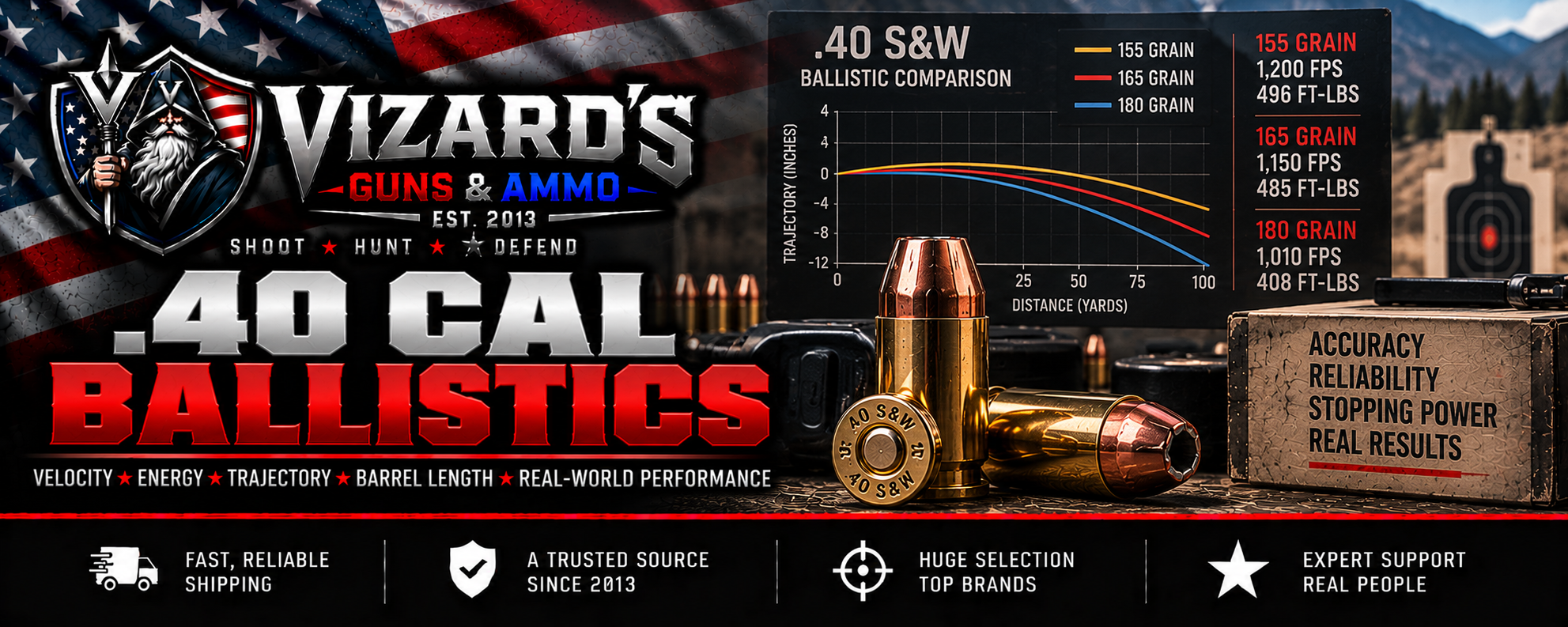
One reason the cartridge is interesting from a ballistics standpoint is the range of bullet weights available. Common .40 S&W ammunition includes 155, 165 and 180 grain bullets, and changing bullet weight can noticeably change velocity, energy and recoil.
But the number printed on the ammunition box is only part of the story.
Barrel length, bullet construction and the particular load all influence performance. Two .40 S&W cartridges with the same bullet weight can produce different velocities because they were engineered differently.
Understanding those differences makes it easier to choose the right .40 S&W ammunition for your firearm.
Understanding .40 S&W Ballistics
Ballistics is usually divided into three areas.
Internal ballistics describes what happens from ignition until the bullet leaves the barrel.
External ballistics describes the bullet's flight after it exits the muzzle.
Terminal ballistics describes what happens when the projectile reaches and interacts with its target.
For most shooters comparing factory .40 S&W ammunition, the most useful numbers are bullet weight, muzzle velocity, muzzle energy and trajectory.
Barrel length also deserves attention because published velocity figures are produced under specific test conditions.
How Fast Is a .40 S&W Bullet?
There isn't one correct velocity for .40 S&W.
Velocity depends heavily on bullet weight and the particular load.
A lighter bullet can generally be driven faster than a heavier projectile in the same cartridge, but ammunition design matters enough that you should compare actual loads rather than assuming every cartridge of a particular weight performs identically.
Current Speer Lawman training ammunition provides a useful example.
Speer lists its 165-grain .40 S&W Lawman TMJ at 1,050 fps, while its 180-grain version is listed at 1,000 fps.
That illustrates one of the fundamental characteristics of the cartridge: as bullet weight increases, velocity commonly decreases.
155 Grain .40 S&W Ballistics
The 155-grain bullet sits toward the lighter end of common .40 S&W ammunition.
Its lower projectile weight allows manufacturers to build loads with relatively high velocity.
That can produce a flatter trajectory over typical handgun distances and can also produce substantial muzzle energy.
But faster does not automatically mean better.
Defensive performance depends on bullet construction, expansion characteristics, penetration and impact velocity, not simply the largest velocity number on the box.
For shooters comparing .40 S&W loads, 155-grain ammunition represents the lighter, faster side of the cartridge's common performance spectrum.
165 Grain .40 S&W Ballistics
The 165-grain bullet is one of the most interesting .40 S&W weights because it sits between lighter 155-grain loads and heavier 180-grain ammunition.
Speer's current published reloading data for its 165-grain Gold Dot hollow point uses a 4-inch universal receiver test barrel. Depending on the propellant used, its published maximum-load velocities range from roughly 1,033 to 1,144 fps.
That doesn't mean every factory 165-grain cartridge travels at those exact speeds. It demonstrates the velocity range that can exist even with the same bullet weight.
Speer's factory Lawman 165-grain TMJ training load is currently listed at 1,050 fps.
The 165-grain weight can therefore provide a useful balance of projectile mass and velocity.
180 Grain .40 S&W Ballistics
The 180-grain bullet is one of the classic .40 S&W loads.
It provides more projectile mass while generally operating at a lower velocity than lighter .40 caliber bullets.
Federal provides a particularly useful real-world example with its 180-grain HST.
Federal's published ballistic table lists the load at:
Muzzle: 1,010 fps
25 yards: 980 fps
50 yards: 954 fps
75 yards: 930 fps
100 yards: 908 fps
Federal lists the corresponding energy figures as:
Muzzle: 408 ft-lbs
25 yards: 384 ft-lbs
50 yards: 364 ft-lbs
75 yards: 346 ft-lbs
100 yards: 329 ft-lbs
Those figures were produced using a 4-inch test barrel.
This is exactly why identifying the ammunition and test barrel is important when publishing ballistic data. It gives the numbers context instead of presenting them as universal performance for every 180-grain .40 S&W cartridge.
155 vs. 165 vs. 180 Grain .40 S&W
The easiest way to think about the three common weights is as a spectrum.
A 155-grain load generally emphasizes velocity.
A 165-grain load occupies the middle ground.
A 180-grain load emphasizes projectile weight while generally operating at a lower velocity.
None is automatically the "best."
A well-designed 180-grain defensive hollow point can perform differently from an inexpensive 180-grain FMJ training round even though both bullets weigh exactly the same.
That's why bullet weight should be treated as one part of the ammunition's overall design.
What Is Muzzle Energy?
Muzzle energy describes the kinetic energy carried by a projectile as it leaves the barrel.
A commonly used formula is:
Energy = Bullet Weight × Velocity² ÷ 450,240
Bullet weight is measured in grains and velocity in feet per second. The result is expressed in foot-pounds of energy.
Velocity is squared in the equation, which means relatively small changes in velocity can have a meaningful effect on calculated energy.
For example, Federal's 180-grain HST traveling at 1,010 fps produces a published muzzle energy of 408 ft-lbs.
Energy is useful for comparing loads, but it shouldn't be treated as a complete measurement of defensive effectiveness.
Bullet construction and terminal behavior matter too.
What Happens to .40 S&W Energy Downrange?
A bullet begins losing velocity after it leaves the barrel.
As velocity decreases, kinetic energy decreases as well.
Federal's 180-grain HST example illustrates this clearly.
It begins at 408 ft-lbs at the muzzle and is listed at 364 ft-lbs at 50 yards and 329 ft-lbs at 100 yards.
For most defensive handgun applications, those longer distances aren't the primary concern.
But the data is still useful because it demonstrates how a handgun bullet loses velocity and energy during flight.
Understanding .40 S&W Trajectory
No bullet travels perfectly straight.
Gravity begins acting on the projectile as soon as it leaves the muzzle.
At ordinary handgun distances, .40 S&W trajectory is relatively easy to manage. As distance increases, however, bullet drop becomes increasingly noticeable.
Velocity plays an important role.
A faster bullet spends less time in flight before reaching a given distance, which generally reduces the amount of gravitational drop during that interval.
This is one reason lighter, faster loads can produce somewhat flatter trajectories than slower heavy bullets.
But trajectory comparisons should always use the same sight-in conditions.
Changing the zero distance or sight height changes the trajectory numbers.
Is .40 S&W a Long-Range Cartridge?
Not really.
The .40 S&W was designed as a handgun cartridge, not as a long-range round.
That doesn't mean the bullet suddenly becomes inaccurate beyond a certain distance.
It means trajectory, velocity loss, firearm sighting systems and shooter limitations become increasingly important as distance increases.
For typical defensive and range use, the cartridge is primarily used at relatively short distances.
Longer-range shooting can still be useful for training because it magnifies errors in sight alignment and trigger control.
How Barrel Length Affects .40 S&W Velocity
Barrel length is one of the most important variables when comparing handgun ballistics.
A manufacturer might publish velocity from a 4-inch test barrel, but your pistol might have a 3.5-inch barrel, 4.5-inch barrel or something else entirely.
You should not assume the same ammunition will produce exactly the published velocity from every handgun.
Hornady specifically explains that individual chambers and barrels can cause actual velocity to be faster or slower than published ammunition specifications.
This is why manufacturer test-barrel information is so valuable.
It establishes the conditions under which the published figure was obtained.
What Happens in a Short-Barreled .40 S&W?
Shortening the barrel generally reduces the amount of time expanding gases have to accelerate the bullet before it exits the muzzle.
That commonly results in lower velocity.
However, there isn't a universal rule that says every inch of barrel always equals a specific velocity change.
Hornady estimates that velocity changes often average roughly 25 to 35 fps per inch of barrel difference, but explicitly cautions that this does not hold true for every load or firearm. The only way to know the actual velocity from a particular handgun is to measure it with a chronograph.
This distinction is particularly important with compact carry pistols.
Speer, for example, says it redesigned its Gold Dot Carry Gun ammunition specifically around the reduced velocity potential of short-barreled handguns. Its .40 S&W Carry Gun load uses a 165-grain bullet rather than the heavier 180-grain projectile used in the corresponding G2 load.
Does a Longer Barrel Always Mean More Velocity?
Within normal handgun barrel lengths, additional barrel length will often increase velocity, but it isn't an unlimited relationship.
Powder burn characteristics, chamber dimensions, bullet weight, pressure and other variables influence the result.
Two pistols with nominally identical barrel lengths can even produce slightly different chronograph readings with the same ammunition.
This is why manufacturer figures are best treated as standardized reference points rather than guarantees for your individual firearm.
Is Faster .40 S&W Ammo Better?
Not necessarily.
Velocity is only one characteristic.
A defensive hollow point must perform correctly at its actual impact velocity.
A bullet traveling faster but failing to provide the desired terminal behavior isn't automatically superior to a slower load with a well-engineered projectile.
The same principle applies to range ammunition.
For training, reliability, consistency, accuracy and manageable recoil can be more important than maximizing velocity.
Bullet Weight and Recoil
Changing bullet weight and velocity can also change how the pistol feels.
Shooters sometimes describe lighter, faster .40 S&W ammunition as having a sharper recoil impulse, while heavier 180-grain ammunition can feel more like a slower push.
Those descriptions are subjective.
Firearm weight, grip shape, recoil spring system, shooting technique and the specific ammunition all influence perceived recoil.
The best way to determine what works for you is to shoot several quality loads through the firearm you actually own.
How Does .40 S&W Compare With 9mm?
The .40 S&W commonly uses heavier bullets than 9mm and can produce substantial muzzle energy.
That generally comes with more recoil and often lower magazine capacity when comparing otherwise similar pistols.
Modern 9mm ammunition and handgun design contributed to many agencies moving back toward 9mm, but that doesn't erase the ballistic capability of .40 S&W.
The two cartridges simply make different tradeoffs.
For someone who already owns a reliable .40 S&W pistol and shoots it well, the cartridge remains entirely relevant.
How Does .40 S&W Compare With 10mm Auto?
The two cartridges use bullets of approximately the same diameter, but they are not interchangeable cartridges.
10mm Auto has a longer case and considerably greater performance potential.
Full-power 10mm ammunition can drive heavy bullets substantially faster than typical .40 S&W ammunition.
That also generally means more recoil.
The .40 S&W was designed to deliver useful performance from a shorter cartridge that could fit into more compact handgun platforms.
Why Real Ballistic Data Matters
Ballistic numbers without context can be misleading.
If someone says a .40 S&W bullet travels at 1,100 fps, several questions should follow.
What bullet weight?
Which load?
What barrel length?
Was that a manufacturer's standardized test barrel or someone's individual handgun?
Was the velocity measured or estimated?
Manufacturer-published data gives us a repeatable reference point.
Actual performance from your firearm may still differ, but at least the comparison starts with documented testing rather than an unexplained number copied from somewhere online.
That's the standard we're using for the ballistic information in this guide.
Frequently Asked Questions About .40 S&W Ballistics
How fast does a .40 S&W bullet travel?
It depends on bullet weight and ammunition design. Common .40 S&W loads generally operate around the neighborhood of 1,000 fps, with lighter bullets capable of higher velocities. For example, Speer currently lists 165-grain Lawman at 1,050 fps and 180-grain Lawman at 1,000 fps.
How much energy does a .40 S&W produce?
Energy varies by load. Federal lists its 180-grain HST at 408 ft-lbs of muzzle energy from a 4-inch test barrel.
What is the fastest common .40 S&W bullet weight?
Lighter bullet weights such as 155 grains generally have greater velocity potential than heavier 165 or 180-grain bullets, although the actual result depends on the specific ammunition.
Is 165 or 180 grain .40 S&W better?
Neither is universally better. A 165-grain load generally offers greater velocity, while a 180-grain load provides greater projectile mass. Bullet construction and intended use are more important than bullet weight alone.
Does barrel length affect .40 S&W velocity?
Yes. Shorter barrels will generally produce lower velocity than longer barrels with the same ammunition, although the exact difference depends on the load and firearm. Hornady notes that individual chambers and barrels also influence actual velocity.
How far can a .40 S&W shoot?
A .40 S&W projectile can physically travel far beyond ordinary handgun distances, but the cartridge is designed primarily for relatively short-range handgun applications. Bullet drop and velocity loss become increasingly significant as distance increases.
Is .40 S&W more powerful than 9mm?
Many .40 S&W loads use heavier bullets and can produce greater muzzle energy than common 9mm loads, but the exact comparison depends on the specific ammunition. The additional performance generally comes with increased recoil.
Continue Exploring .40 S&W
Best .40 Cal Ammo: Top .40 S&W Loads for Self-Defense & the Range
.40 S&W Ballistics: Velocity, Energy, Trajectory & Barrel Length
You are here