
9mm Ballistics
21st Mar 2025
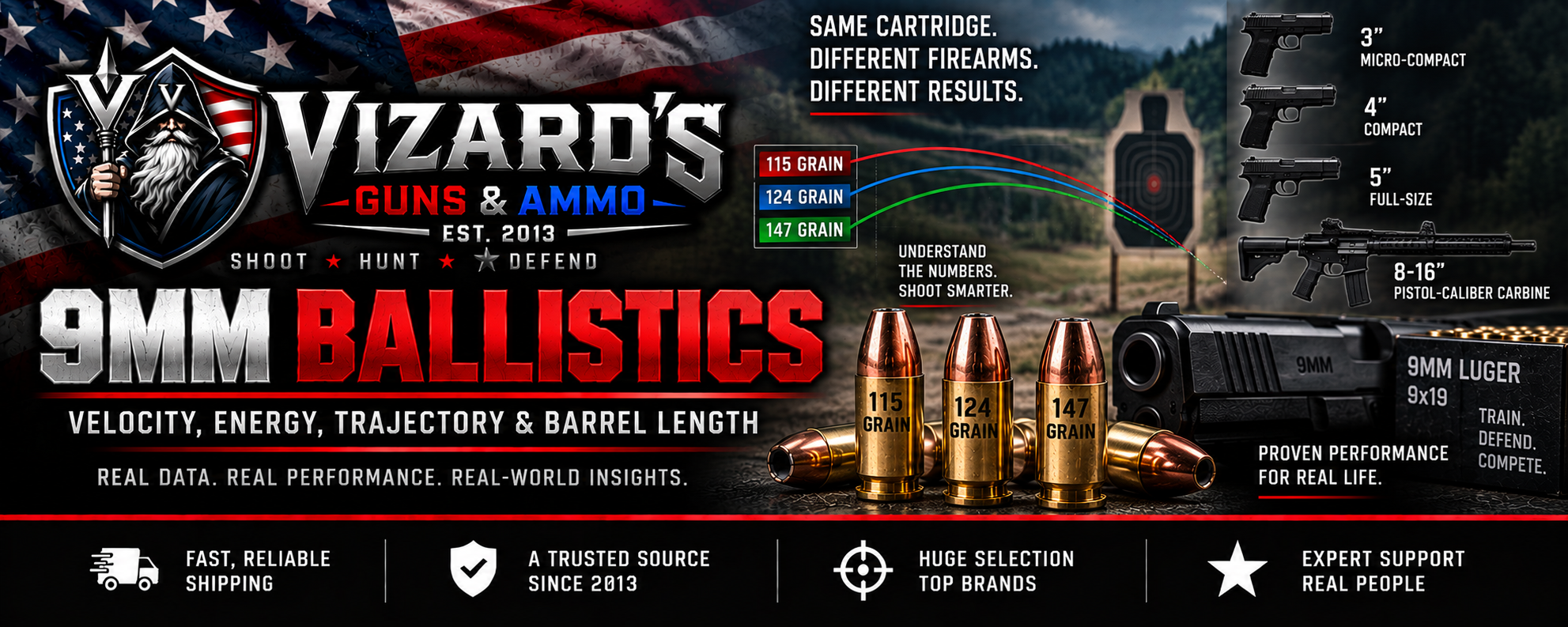
9mm Ballistics: Velocity, Energy, Trajectory & Barrel Length
9mm ballistics can look simple until you start comparing ammunition.
Pick up three boxes of 9mm Luger and you might have a 115 grain load, a 124 grain load and a 147 grain load sitting next to each other. All three fit the same caliber firearm, but they don't necessarily leave the muzzle at the same velocity, carry the same energy or follow exactly the same trajectory.
Then there is barrel length.
A velocity printed on an ammunition box or manufacturer website was produced under particular test conditions. Fire the same ammunition from a short concealed carry pistol and a longer barreled handgun and the results can change.
That's why understanding 9mm ballistics is more useful than memorizing a single velocity number.
Understanding 9mm Ballistics
When shooters talk about ballistics, several measurements tend to come up repeatedly.
Velocity tells us how fast the projectile is traveling.
Energy describes the projectile's kinetic energy at a particular point in its flight.
Trajectory describes the path the bullet follows after leaving the barrel.
Bullet weight tells us the mass of the projectile, normally expressed in grains.
Barrel length can influence the velocity produced by a particular load.
None of these measurements should be viewed completely by itself. They work together to describe how a particular cartridge performs.
How Fast Is a 9mm Bullet?
There isn't one correct velocity for all 9mm ammunition.
Different bullet weights and loads produce different velocities.
A good real-world example comes from Speer's published data for its Lawman training ammunition. Using a 4-inch test barrel, Speer reports the following muzzle velocities:
115 grain TMJ: 1,200 fps
124 grain TMJ: 1,090 fps
147 grain TMJ: 985 fps
Because all three were tested using the same 4-inch barrel length, this gives us a useful comparison between common 9mm bullet weights.
But don't turn those numbers into a universal rule.
Another manufacturer's 115 grain ammunition can be faster or slower. A defensive 124 grain +P load can behave differently from an ordinary 124 grain training load. A different barrel length can change the result again.
The number belongs to the specific load and test conditions, not simply to the words "115 grain" or "124 grain."
115 Grain 9mm Ballistics
115 grain is one of the most common 9mm bullet weights, particularly for range ammunition.
Because the projectile is relatively light, 115 grain ammunition is commonly loaded to higher velocities than heavier conventional 9mm loads.
Speer's 115 grain Lawman load, for example, is rated at 1,200 fps from a 4-inch test barrel and produces 368 ft-lbs of muzzle energy.
That does not mean every 115 grain 9mm cartridge produces 1,200 fps.
Different manufacturers use different bullets, powders and load specifications. Even within one manufacturer's catalog, two loads using the same bullet weight can produce different velocities.
For the shooter, 115 grain remains particularly relevant because there is such a large selection of training and range ammunition available in this weight.
124 Grain 9mm Ballistics
124 grain sits between the common 115 and 147 grain options and has become an extremely versatile 9mm bullet weight.
You'll encounter 124 grain ammunition in ordinary FMJ or TMJ training loads as well as premium defensive ammunition.
Speer's standard-pressure 124 grain Lawman training load is rated at 1,090 fps from a 4-inch test barrel, producing 327 ft-lbs of muzzle energy.
That illustrates why bullet weight alone doesn't tell the entire story.
There are also 124 grain defensive loads and higher-pressure +P loads with different performance specifications.
If someone asks, "How fast does a 124 grain 9mm travel?" the better answer is to identify the exact ammunition before giving them a number.
147 Grain 9mm Ballistics
147 grain is one of the heavier mainstream bullet weights for 9mm Luger.
Speer's 147 grain Lawman training load is rated at 985 fps from a 4-inch test barrel with 317 ft-lbs of muzzle energy.
Notice what happened compared with the 115 grain load.
Bullet weight increased.
Velocity decreased.
But muzzle energy did not fall in direct proportion to velocity because energy is affected by both projectile mass and velocity.
This is one reason looking only at feet per second can be misleading.
Many 147 grain 9mm loads also operate at subsonic velocities, which makes this bullet weight popular with some suppressed shooters.
That doesn't mean every 147 grain 9mm load is subsonic.
There are exceptions. Federal, for example, has published a 147 grain 9mm Punch load at 1,150 fps.
The lesson is important: never assume performance from bullet weight alone.
115 vs. 124 vs. 147 Grain 9mm
Using the three Speer Lawman loads gives us a particularly clean comparison because they use the same published 4-inch test-barrel length.
115 Grain
Muzzle Velocity: 1,200 fps
Muzzle Energy: 368 ft-lbs
50 Yard Velocity: 1,098 fps
100 Yard Velocity: 1,024 fps
124 Grain
Muzzle Velocity: 1,090 fps
Muzzle Energy: 327 ft-lbs
50 Yard Velocity: 1,019 fps
100 Yard Velocity: 965 fps
147 Grain
Muzzle Velocity: 985 fps
Muzzle Energy: 317 ft-lbs
50 Yard Velocity: 932 fps
100 Yard Velocity: 888 fps
These numbers shouldn't be used to declare one bullet weight the winner.
They show what happens with these three specific loads under standardized manufacturer testing.
A shooter comparing defensive ammunition, competition ammunition or another manufacturer's loads could see different results.
What Is Muzzle Energy?
Muzzle energy describes the kinetic energy of a projectile as it leaves the barrel and is normally expressed in foot-pounds.
Energy depends on both bullet mass and velocity.
The basic relationship is:
Energy = Bullet Weight × Velocity² ÷ 450,240
Bullet weight is measured in grains and velocity in feet per second.
The important part is that velocity is squared.
That means changes in velocity can have a substantial effect on calculated energy.
This is also why a lighter, faster projectile can produce more muzzle energy than a heavier, slower projectile.
Using Speer's Lawman data again, its 115 grain load produces 368 ft-lbs at the muzzle, while its heavier 147 grain load produces 317 ft-lbs.
That doesn't automatically make the 115 grain load "better."
Muzzle energy is one measurement, not a complete evaluation of ammunition performance.
What Happens to Energy Downrange?
A bullet begins losing velocity after it leaves the muzzle.
As velocity falls, energy falls too.
Speer's 115 grain Lawman load provides a clear example.
It starts at 1,200 fps and 368 ft-lbs at the muzzle. At 50 yards, Speer lists 1,098 fps and 308 ft-lbs. At 100 yards, the published figures are 1,024 fps and 268 ft-lbs.
The 124 grain load starts at 327 ft-lbs and is listed at 286 ft-lbs at 50 yards and 256 ft-lbs at 100 yards.
The 147 grain load starts at 317 ft-lbs and is listed at 284 ft-lbs at 50 yards and 257 ft-lbs at 100 yards.
Something interesting happens there.
Although the 115 grain projectile begins with substantially more muzzle energy in this comparison, the energy figures are much closer by 100 yards.
Ballistics are dynamic. The relationships between different bullets change as they travel downrange.
Understanding 9mm Trajectory
Bullets don't travel in perfectly straight lines.
Gravity begins acting on a projectile as soon as it leaves the barrel.
When a firearm is sighted in, the barrel and sighting system are arranged so the projectile's curved path intersects the shooter's line of sight at a chosen distance.
Speer's published handgun trajectory figures are based on a 25-yard sight-in with a 0.9-inch sight height. Under those conditions, its 115 grain Lawman load is listed at 0.8 inch below line of sight at 50 yards, 3.3 inches low at 75 yards and 7.8 inches low at 100 yards.
Its 124 grain load is listed at 1.1 inches low at 50 yards, 4.2 inches low at 75 and 9.6 inches low at 100.
The 147 grain load is listed at 1.5 inches low at 50 yards, 5.5 inches low at 75 and 12 inches low at 100.
That's a much more useful way to discuss trajectory than simply saying one bullet is "flat shooting."
You need to know the ammunition and sight-in conditions.
Does Barrel Length Affect 9mm Velocity?
Yes, but not by one fixed number.
When a cartridge fires, expanding gases accelerate the bullet down the barrel.
Changing barrel length changes the amount of time and distance available for that process.
In many load and firearm combinations, a longer barrel produces greater velocity than a shorter barrel. But the size of that change depends on the ammunition, powder characteristics, firearm and other variables.
This matters today because 9mm is chambered in firearms with dramatically different barrel lengths.
A micro-compact concealed carry pistol may have a barrel around 3 inches long.
A conventional duty or service pistol may be closer to 4 or 5 inches.
A 9mm pistol-caliber carbine can have a much longer barrel.
It would be a mistake to expect one published velocity number to describe performance from all of them.
Why Manufacturer Test-Barrel Length Matters
Whenever you're comparing ammunition specifications, look for the manufacturer's test-barrel length.
This detail is easy to overlook.
Speer's Lawman 115, 124 and 147 grain figures used throughout this article were all produced with a 4-inch test barrel.
Federal's published 9mm Syntech reloading data likewise specifies a 4-inch SAAMI chamber universal receiver test barrel, illustrating how manufacturers identify the test equipment behind ballistic figures.
If another manufacturer publishes a velocity measured from a different barrel length, directly comparing the two numbers without accounting for the test setup can give you the wrong impression.
Short Barrel 9mm Ballistics
Short-barreled 9mm pistols deserve special attention because they are extremely common for concealed carry.
A compact pistol may not reproduce the same velocity printed for ammunition tested from a longer barrel.
That doesn't mean short-barreled pistols don't work.
It means ammunition should be evaluated in the context of the firearm that will actually fire it.
This can be particularly important with defensive ammunition because projectile performance can depend partly on impact velocity.
Some manufacturers even develop ammunition specifically around compact and short-barreled handguns.
Speer, for example, offers its Gold Dot Carry Gun line with adjustments intended for performance from smaller, short-barreled defensive pistols.
Is Faster 9mm Ammo Better?
Not automatically.
Velocity is useful information, but the highest number on the box doesn't automatically identify the best ammunition.
For range use, reliability, consistency, accuracy and cost may matter more than maximum velocity.
For competition, recoil characteristics and the rules of the shooting discipline may become important.
For defensive ammunition, projectile design and reliable functioning in the firearm are critical considerations in addition to velocity.
A faster projectile isn't automatically a better projectile.
Ballistic data should help you understand ammunition, not replace thinking about its intended purpose.
Standard Pressure vs. +P 9mm Ballistics
9mm +P ammunition is loaded to a higher pressure specification than standard-pressure 9mm ammunition.
Depending on the load, this can produce increased velocity and energy.
But "+P" shouldn't be interpreted as a universal performance rating.
Two different loads can use different projectiles and produce different ballistic results.
Higher pressure can also increase recoil and firearm wear.
Most importantly, use +P ammunition only in firearms whose manufacturers approve it.
If you're comparing standard and +P ammunition, compare the actual published ballistic specifications for the specific loads rather than assuming the +P label tells you everything you need to know.
Does Bullet Weight Affect Recoil?
Yes, but bullet weight is only part of the recoil equation.
Projectile mass, velocity, powder charge and firearm weight can all affect what the shooter experiences.
Two 124 grain loads don't necessarily feel identical.
Likewise, a shooter may perceive the recoil impulse of a 147 grain load differently from a faster 115 grain load even when both are perfectly manageable.
This is one reason actual range time matters.
Ballistic specifications can tell you a lot about a cartridge, but they can't tell you exactly how a particular load will feel in your particular handgun.
What Is the Best 9mm Bullet Weight?
There isn't one best weight for every use.
115 grain offers a huge selection of range and training ammunition and is commonly associated with higher velocities.
124 grain provides a middle ground and is available in a wide variety of training and defensive loads.
147 grain provides a heavier projectile at generally lower conventional velocities and is popular in certain defensive, competition and suppressed applications.
Instead of asking which weight is universally best, ask which specific load is best suited to what you're trying to accomplish.
For our recommendations by use, see our Best 9MM Ammo guide.
Why Real Ballistic Data Matters
It's easy to find generic charts online claiming that "9mm goes this fast" or that a particular bullet weight always produces a certain amount of energy.
Real ammunition doesn't work that way.
A useful ballistic number should tell you where it came from.
What ammunition was tested?
What bullet weight?
What barrel length?
Was it standard pressure or +P?
At what distance was velocity measured?
How was the firearm sighted when trajectory was calculated?
Without that context, an impressive-looking number can tell you surprisingly little.
That's why our ballistics guides use identifiable manufacturer data where possible rather than presenting generic estimates as universal facts.
Frequently Asked Questions About 9mm Ballistics
How fast does a 9mm bullet travel?
It depends on the load and firearm. As one standardized example, Speer's 4-inch-barrel Lawman data lists 1,200 fps for its 115 grain load, 1,090 fps for its 124 grain load and 985 fps for its 147 grain load.
How much muzzle energy does a 9mm have?
There is no single figure for all 9mm ammunition. The same three Speer Lawman loads produce published muzzle energies of 368 ft-lbs for 115 grain, 327 ft-lbs for 124 grain and 317 ft-lbs for 147 grain.
Is 115 grain faster than 124 grain 9mm?
It commonly is when comparing conventional loads from the same product family, but not universally. Load pressure, bullet design, powder and other factors affect velocity.
Is 147 grain 9mm subsonic?
Many 147 grain loads are subsonic, but not all. Always check the manufacturer's velocity specification for the specific ammunition and remember that actual firearm velocity can vary.
How much does a 9mm bullet drop at 100 yards?
It depends on the load and sight-in. With a 25-yard sight-in, Speer publishes 100-yard trajectory figures of 7.8 inches low for its 115 grain Lawman, 9.6 inches low for the 124 grain load and 12 inches low for the 147 grain load.
Does a longer barrel make 9mm faster?
A longer barrel can increase velocity compared with a shorter barrel, but there is no universal number of feet per second gained per inch. The result depends on the ammunition and firearm.
Does 9mm lose energy at 100 yards?
Yes. A projectile loses velocity during flight, which also reduces its kinetic energy. The amount retained depends on the particular bullet and load.
Which has more energy, 115 or 147 grain 9mm?
It depends on the loads being compared. In Speer's standard Lawman example, the 115 grain load has greater muzzle energy at 368 ft-lbs compared with 317 ft-lbs for the 147 grain load. That does not establish a universal rule for every 115 and 147 grain 9mm cartridge.
Continue Exploring 9mm
Learn more about 9mm ammunition with the rest of our 9mm guides.
History of the 9mm: Origins, Development & Legacy
9mm Ballistics: Velocity, Energy, Trajectory & Barrel Length
You are here.