.38 Special Ballistics
Posted by Vizards Guns And Ammo on 8th Sep 2026
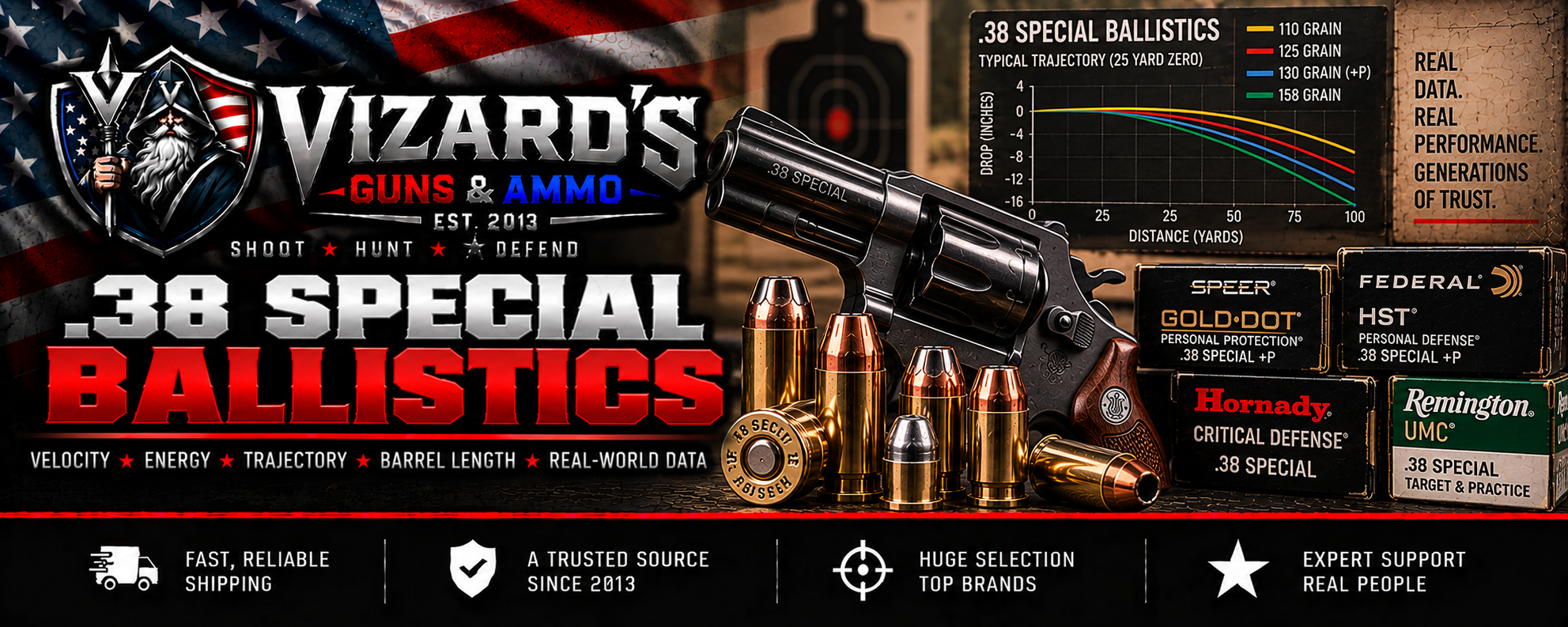
.38 Special Ballistics: Velocity, Energy, Trajectory & Barrel Length
The .38 Special is a great example of why handgun ballistics cannot be reduced to one velocity or energy number.
A mild target load fired from a full-size revolver can perform very differently from a +P defensive hollow point fired from a two-inch snub nose. Bullet weight, pressure, barrel length and bullet construction all influence what happens when the cartridge is fired.
That is especially important with the .38 Special because the cartridge is used in such a wide variety of revolvers. Some have barrels around two inches long and are designed for concealed carry. Others use four-inch or longer barrels and are intended for range shooting, home defense or general-purpose use.
Understanding those differences makes published ballistic data much more useful.
Understanding .38 Special Ballistics
When shooters talk about ballistics, they are usually discussing several different things.
Velocity tells us how fast the bullet is traveling.
Energy provides a mathematical measurement of the kinetic energy carried by that projectile.
Trajectory describes the bullet's path after it leaves the barrel.
Terminal ballistics describes how the bullet behaves after impact.
All of these are related, but none tells the entire story by itself.
With .38 Special, barrel length deserves particular attention because many defensive revolvers use extremely short barrels.
How Fast Is a .38 Special Bullet?
There is no single velocity for .38 Special ammunition.
Some traditional target ammunition travels at less than 700 feet per second, while defensive +P ammunition can produce substantially greater velocity.
Speer provides a good illustration.
The company describes a .38 Special target load propelling a 149-grain bullet at about 690 fps. Its 135-grain Gold Dot Short Barrel +P defensive load, on the other hand, is rated at 860 fps from a two-inch vented test barrel.
That is a substantial difference within the same cartridge.
This is why saying ".38 Special travels at X fps" without identifying the load doesn't tell you very much.
Common .38 Special Bullet Weights
The .38 Special has been loaded with a wide range of projectiles during its long history.
For modern factory ammunition, you will commonly encounter weights around 110, 125, 130, 135, 148 and 158 grains.
Each fills a somewhat different role.
Lighter bullets can generally be driven faster.
Heavier bullets carry greater projectile mass but usually operate at lower velocities.
The 148-grain wadcutter has a particularly strong association with target shooting, while 158 grains is one of the traditional heavyweight choices for the cartridge.
Modern defensive ammunition has also made 110, 125, 130 and 135-grain loads increasingly important.
110 Grain .38 Special Ballistics
A 110-grain bullet sits toward the lighter end of common .38 Special ammunition.
Reducing bullet weight gives ammunition designers the ability to achieve greater velocity within the cartridge's pressure limitations.
This can be useful with short barrels because a compact revolver does not provide much barrel length for acceleration.
Hornady's 110-grain Critical Defense is an example of ammunition designed specifically around concealed-carry firearms. Hornady says Critical Defense ammunition is optimized for short-barreled handguns and uses its FTX bullet to provide expansion at defensive velocities.
This illustrates an important principle.
The bullet's construction matters just as much as its weight.
125 Grain .38 Special Ballistics
The 125-grain bullet provides another relatively light .38 Special option.
Speer's published Gold Dot data gives us a useful manufacturer reference.
Its 125-grain .38 Special +P Gold Dot is listed at:
Muzzle velocity: 945 fps
50 yards: 891 fps
100 yards: 845 fps
Muzzle energy: 248 ft-lbs
50 yards: 220 ft-lbs
100 yards: 198 ft-lbs
Speer produced those figures using a 4-inch vented test barrel.
That barrel specification matters.
You should not assume the same ammunition will produce 945 fps from a two-inch concealed-carry revolver.
130 Grain .38 Special +P Ballistics
Federal has developed several interesting 130-grain defensive .38 Special loads.
Published Federal HST Micro data for its 130-grain .38 Special +P load lists:
Muzzle velocity: 890 fps
25 yards: 866 fps
50 yards: 844 fps
75 yards: 823 fps
100 yards: 803 fps
The corresponding energy figures are:
Muzzle: 229 ft-lbs
25 yards: 217 ft-lbs
50 yards: 206 ft-lbs
75 yards: 196 ft-lbs
100 yards: 186 ft-lbs
Federal's published data identifies a 4-inch vented test barrel for these figures.
Federal has also tested its newer 130-grain Hydra-Shok Deep +P from a much shorter 1.875-inch revolver barrel, illustrating how manufacturers increasingly design defensive .38 Special ammunition around actual concealed-carry guns.
135 Grain .38 Special +P Ballistics
Speer's 135-grain Gold Dot Short Barrel +P is especially useful when discussing real-world .38 Special ballistics.
Unlike data generated from a longer test barrel, Speer's published specifications for this load use a two-inch vented test barrel intended to simulate revolver performance.
Speer lists:
Muzzle velocity: 860 fps
50 yards: 818 fps
100 yards: 780 fps
Muzzle energy: 222 ft-lbs
50 yards: 200 ft-lbs
100 yards: 182 ft-lbs.
Speer's trajectory figures use a 25-yard sight-in with a sight height of 0.9 inch.
Under those conditions, the company lists the bullet path at approximately:
50 yards: -2.2 inches
75 yards: -7.6 inches
100 yards: -16.4 inches.
Those numbers help demonstrate how quickly trajectory becomes a consideration as distance increases with a relatively low-velocity handgun cartridge.
148 Grain .38 Special Wadcutter Ballistics
The 148-grain wadcutter occupies a special place in .38 Special history.
Instead of being designed primarily for maximum velocity, wadcutters became closely associated with precision target shooting.
Their flat-front bullet design cuts a clean, easily scored hole in a paper target.
Federal's published Gold Medal .38 Special data provides a classic example.
Its 148-grain lead wadcutter was listed at approximately 690 fps with about 155 ft-lbs of muzzle energy.
Those numbers look modest compared with defensive +P ammunition.
That is intentional.
A target load doesn't need to maximize velocity or energy. Accuracy, consistency and manageable recoil are more important for that application.
158 Grain .38 Special Ballistics
The 158-grain bullet is one of the traditional .38 Special weights.
It has appeared in lead round nose, semi-wadcutter, hollow-point and other configurations throughout the cartridge's history.
Because it is heavier, a 158-grain bullet will generally operate at a lower velocity than lighter projectiles when pressure and other factors are comparable.
That does not automatically make it less effective.
Projectile construction, pressure level and barrel length still matter.
Speer, for example, describes its 158-grain Lawman .38 Special +P training ammunition at approximately 900 fps.
That is substantially faster than mild target ammunition of similar weight because the two loads were designed for different purposes.
Standard Pressure vs. +P Ballistics
One of the biggest distinctions in .38 Special ammunition is standard pressure versus +P.
+P ammunition is loaded to a higher pressure specification than ordinary .38 Special.
That additional pressure can be used to increase velocity.
Speer notes that its .38 Special +P loads can produce roughly 20 percent more muzzle energy than comparable standard loads in the example it discusses.
But +P isn't automatically the correct choice for every revolver.
Only use +P ammunition in firearms approved by their manufacturer for +P ammunition.
This is especially important with older .38 Special revolvers.
Does +P Mean a More Powerful Bullet?
Generally, +P ammunition provides greater ballistic performance than comparable standard-pressure ammunition, but the label alone doesn't tell you everything.
Bullet weight and construction still matter.
A carefully engineered standard-pressure defensive bullet can potentially make more sense in a firearm that isn't rated for +P than attempting to chase higher velocity.
Recoil matters too.
A small lightweight revolver can feel dramatically different when loaded with hotter ammunition.
For defensive use, controllability and accuracy are part of the equation.
What Is Muzzle Energy?
Muzzle energy is calculated from bullet weight and velocity.
A commonly used formula is:
Energy = Bullet Weight × Velocity² ÷ 450,240
Bullet weight is entered in grains and velocity in feet per second. The result is expressed in foot-pounds.
Velocity is squared in the formula.
That means increasing velocity can have a substantial effect on calculated energy.
For example, Speer's 135-grain Short Barrel +P at 860 fps produces 222 ft-lbs of published muzzle energy.
Federal's 148-grain target wadcutter at 690 fps produces only about 155 ft-lbs.
Those cartridges are both .38 Special, but they were designed for completely different purposes.
Does More Energy Mean Better Ammunition?
No.
Muzzle energy is useful for comparison, but it doesn't tell you what the bullet will actually do after impact.
A defensive bullet needs appropriate penetration and expansion.
A target bullet needs accuracy and consistency.
A projectile can have an impressive energy figure and still be poorly suited to a particular application.
Bullet construction matters enormously, especially with .38 Special because velocity can be relatively modest.
Speer makes the same broader point in its discussion of compact defensive ammunition: bullet construction can matter as much as, or more than, raw speed.
Understanding .38 Special Trajectory
Every bullet begins dropping under gravity after leaving the barrel.
At ordinary defensive handgun distances, trajectory isn't usually the shooter's biggest concern.
As distance increases, however, the relatively modest velocity of .38 Special becomes increasingly apparent.
Speer's 135-grain Short Barrel +P provides a good example.
With its specified 25-yard sight-in, Speer lists approximately 2.2 inches of drop relative to the line of sight at 50 yards and 16.4 inches at 100 yards.
That doesn't mean a .38 Special suddenly becomes unusable at longer distances.
It means the shooter needs to understand the increasingly curved trajectory.
Is .38 Special Accurate?
The cartridge itself is capable of excellent accuracy.
The long association between .38 Special and precision revolver competition demonstrates that.
The bigger limitation with a compact defensive revolver is often the firearm rather than the inherent accuracy of the cartridge.
A short sight radius, small sights, lightweight frame and heavy double-action trigger can make a two-inch snub nose much harder to shoot accurately than a larger target revolver.
Put the same cartridge into a well-made full-size revolver with good sights, and the shooting experience can be completely different.
Why Barrel Length Matters So Much
Barrel length deserves more attention with .38 Special than it receives in many ballistic comparisons.
Ammunition manufacturers produce published velocity figures under particular test conditions.
If the manufacturer used a four-inch test barrel and you carry a revolver with a barrel under two inches, you shouldn't assume your gun will produce the exact same velocity.
Hornady specifically explains that individual chambers and barrels can cause real firearm velocities to be faster or slower than its published test-barrel figures.
This is why we identify the test barrel whenever reliable manufacturer information is available.
Two-Inch vs. Four-Inch .38 Special
A two-inch revolver gives expanding propellant gases less barrel length over which to accelerate the bullet.
A four-inch barrel provides additional acceleration time.
The result is generally higher velocity from the longer barrel when everything else is equal.
But there isn't one universal number for velocity gained per inch.
Powder burn rate, bullet weight, chamber dimensions, cylinder gap and the particular firearm all influence the result.
Revolvers add another variable because gas can escape through the gap between the cylinder and barrel.
That is why some manufacturer data specifies a vented test barrel to better approximate revolver performance.
What Does "Vented Test Barrel" Mean?
This is something worth understanding when reading .38 Special ballistic charts.
A semiautomatic pistol has a closed chamber and barrel system during the initial firing cycle.
A revolver has a small gap between the front of the cylinder and the rear of the barrel.
Some propellant gas escapes through that cylinder gap.
A vented ballistic test barrel attempts to account for this characteristic when generating revolver ammunition data.
When Speer identifies its two-inch test barrel as 2-V, the V indicates a vented barrel simulating revolver performance.
That makes the published figure more useful when comparing ammunition intended for actual revolvers.
Snub-Nose .38 Special Ballistics
A short-barreled revolver creates one of the cartridge's most demanding ballistic environments.
You have limited barrel length, relatively modest cartridge pressure and gas loss through the cylinder gap.
That is why modern short-barrel ammunition is so interesting.
Speer designed its 135-grain Gold Dot Short Barrel +P specifically for this application and publishes performance from a two-inch vented barrel.
Federal tests its 130-grain Hydra-Shok Deep +P from a 1.875-inch revolver and reports 13.2 inches of penetration with expansion to 0.551 inch in its bare-gelatin testing. Through FBI-standard heavy clothing, Federal reports 13.4 inches of penetration and expansion to 0.548 inch from the same short barrel.
Those results demonstrate how modern bullet engineering can compensate for some of the velocity limitations associated with compact revolvers.
Does a Longer Barrel Always Make .38 Special Better?
Not necessarily.
A longer barrel will generally provide more velocity, but "better" depends on the application.
A six-inch target revolver isn't nearly as convenient to conceal as a two-inch snub nose.
A short-barreled revolver sacrifices some ballistic performance in exchange for compact size.
That is a practical tradeoff rather than a flaw.
Modern ammunition manufacturers recognize it and design certain loads specifically around compact firearms.
.38 Special vs. .357 Magnum Ballistics
These cartridges are closely related, but their performance is very different.
The .357 Magnum uses a longer case and operates at substantially higher pressure.
That gives it much greater velocity and energy potential.
The tradeoff is significantly greater recoil, muzzle blast and noise.
A revolver chambered for .357 Magnum can generally also fire .38 Special ammunition, which gives shooters the option of using the milder cartridge for practice.
A revolver chambered only for .38 Special should never be fired with .357 Magnum ammunition.
Speer likewise notes that .38 Special can be safely fired in .357 Magnum revolvers, while the longer .357 Magnum cartridge generally will not chamber in .38 Special revolvers.
.38 Special vs. 9mm Ballistics
Modern 9mm ammunition generally operates at higher velocities than typical .38 Special ammunition.
But the comparison is complicated by firearm type.
Most 9mm ammunition is fired from semiautomatic pistols, while .38 Special is primarily associated with revolvers.
The cartridges also operate at different pressure levels and use different case designs.
9mm generally provides greater capacity in a semiautomatic pistol.
The .38 Special's continued appeal comes largely from the revolvers chambered for it, particularly compact concealed-carry guns and traditional full-size revolvers.
The better choice depends on the firearm and intended use rather than a single ballistic number.
Is .38 Special Powerful Enough for Self-Defense?
Modern .38 Special defensive ammunition can provide useful terminal performance, particularly when the ammunition is engineered around short-barreled revolvers.
Federal's Hydra-Shok Deep testing is a good example of how far bullet technology has progressed. Its 130-grain +P load produced more than 13 inches of penetration while expanding beyond .54 inch in Federal's testing from a 1.875-inch barrel.
That doesn't mean every .38 Special load will perform that way.
A traditional target wadcutter and a modern defensive hollow point are very different products.
Choose ammunition according to its intended purpose.
How Much Velocity Does .38 Special Lose From a Short Barrel?
There isn't one universal answer.
You may see rules of thumb assigning a fixed velocity loss for every inch of barrel removed, but real ammunition doesn't behave that neatly.
Different powders, bullets, pressure levels and firearms produce different results.
Cylinder gap also varies between revolvers.
The best comparison uses chronograph data from the same ammunition fired through different barrel lengths.
If that isn't available, manufacturer data from a barrel close to your own firearm is more useful than simply applying a generic velocity-loss formula.
Why Published Ballistics and Your Revolver May Differ
Even when your barrel length matches the manufacturer's test barrel, your chronograph result may not be identical.
Manufacturing tolerances matter.
Chamber dimensions matter.
Barrel dimensions matter.
Cylinder gap matters.
Temperature and atmospheric conditions can also affect results.
Hornady explicitly cautions that individual chambers and barrels can produce velocities above or below published specifications.
Published manufacturer data should therefore be treated as a standardized reference, not a guarantee that every firearm will produce exactly the same number.
Frequently Asked Questions About .38 Special Ballistics
How fast does a .38 Special bullet travel?
It depends heavily on the load. Mild target ammunition can operate around 690 fps, while defensive +P loads can reach substantially greater velocities. Speer's 135-grain Gold Dot Short Barrel +P, for example, is rated at 860 fps from a two-inch vented test barrel.
How much energy does .38 Special produce?
Energy varies significantly. Speer's 135-grain Gold Dot Short Barrel +P is rated at 222 ft-lbs at the muzzle, while Federal's 148-grain Gold Medal target wadcutter has been listed at approximately 155 ft-lbs.
What is the best barrel length for .38 Special?
There is no universal best length. Two-inch barrels maximize concealability, while four-inch and longer barrels generally provide greater velocity, a longer sight radius and easier shooting.
Does .38 Special +P have more velocity?
Generally, yes. +P ammunition operates at a higher pressure specification and can produce greater velocity and energy than comparable standard-pressure loads. Only use it in a firearm approved for +P ammunition.
What is the best bullet weight for .38 Special?
It depends on the purpose. Lightweight bullets can provide greater velocity, 148-grain wadcutters have a long target-shooting tradition, and 158 grains is one of the classic general-purpose weights. Modern defensive loads commonly use lighter projectiles engineered specifically for expansion at .38 Special velocities.
How much does .38 Special drop at 100 yards?
It depends on the ammunition and zero. As one documented example, Speer's 135-grain Gold Dot Short Barrel +P is listed at approximately 16.4 inches below line of sight at 100 yards when using Speer's specified 25-yard sight-in conditions.
Is .38 Special more powerful than 9mm?
Typical modern 9mm ammunition generally produces greater velocity and energy than standard .38 Special, although exact comparisons depend on the loads and firearms being tested.
Is .38 Special less powerful than .357 Magnum?
Yes. .357 Magnum has substantially greater velocity and energy potential. Many .357 Magnum revolvers can also fire .38 Special, but .357 Magnum ammunition must not be fired from a firearm chambered only for .38 Special.
Continue Exploring .38 Special
Best .38 Special Ammo: Top Loads for Self-Defense & the Range
.38 Special Ballistics: Velocity, Energy, Trajectory & Barrel Length
You are here