History of the .380 ACP Ammo
Posted by Vizards Guns And Ammo on 7th Sep 2026
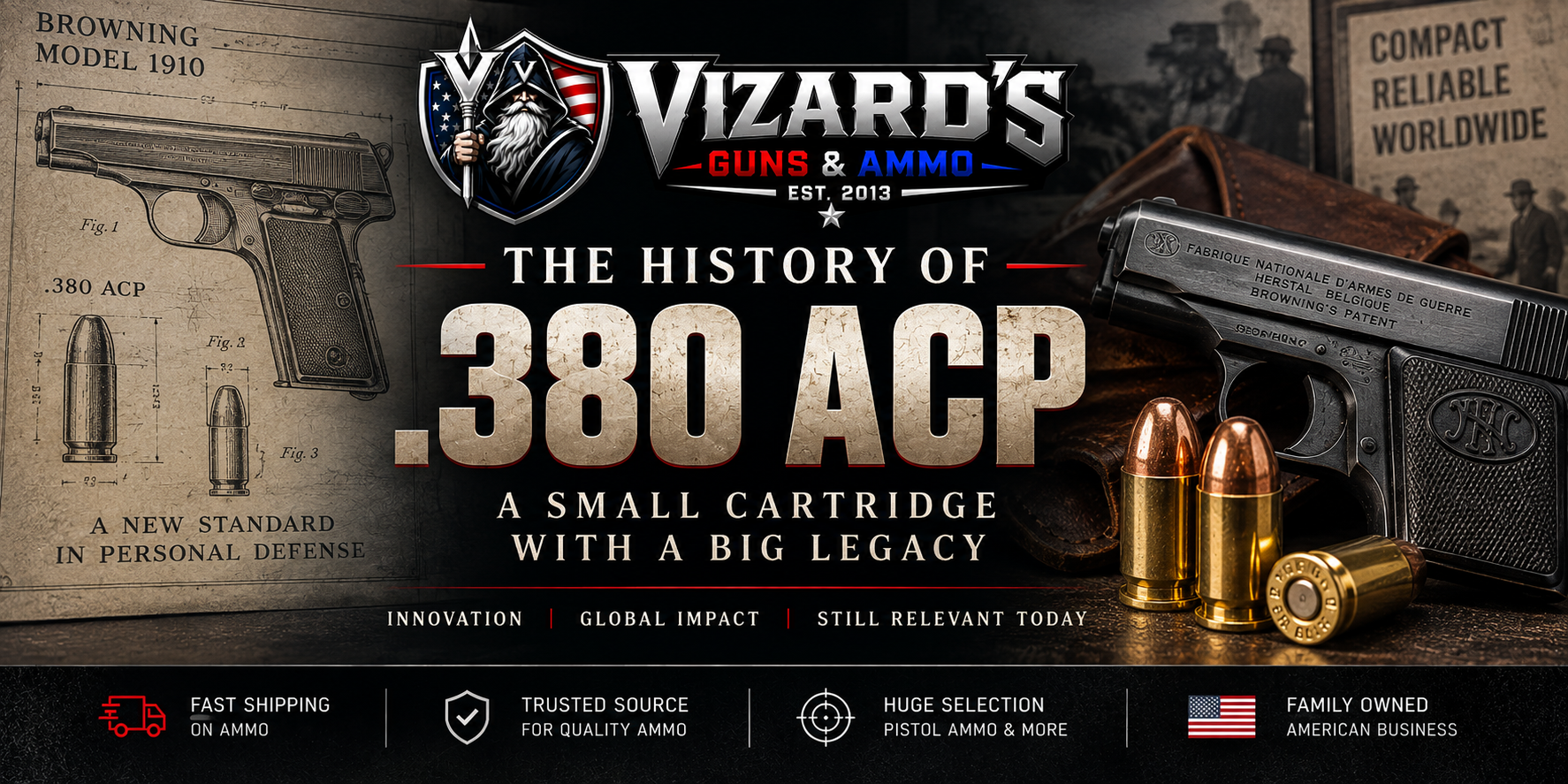
The History of .380 ACP Ammo: From John Browning to the Modern Pocket Pistol
The .380 ACP has been around for more than a century, yet it remains one of the most recognizable cartridges for compact semi-automatic pistols. Developed during the early days of the modern self-loading handgun, .380 ACP combined relatively compact dimensions with enough performance to establish an enduring place in the handgun market.
Its history is closely connected to legendary firearm designer John Moses Browning, Colt's early semi-automatic pistols and the development of compact handguns during the opening years of the 20th century.
Today, the cartridge remains widely available in both traditional range ammunition and modern defensive loads. Shooters interested in currently available options can also read our Best .380 ACP Ammo guide or browse .380 ACP Ammo at Vizard's Guns & Ammo.
When Was .380 ACP Invented?
The .380 ACP was introduced in the United States in 1908, during an important period in the development of semi-automatic handguns.
John Moses Browning had already been developing successful self-loading pistols and cartridges. His work included the .32 ACP and other early automatic pistol cartridges that helped establish the basic concept of compact semi-automatic handguns.
For the new cartridge, Browning created a shorter, rimless design that became the .380 ACP, or .380 Automatic Colt Pistol. Colt introduced it commercially in its .380-caliber Pocket Automatic Pistol in 1908.
More than a century later, both the cartridge and the basic concept behind it remain relevant.
What Does .380 ACP Mean?
ACP stands for Automatic Colt Pistol.
The name is closely associated with a family of cartridges developed during John Browning's work with Colt.
Although American shooters commonly know the cartridge as .380 ACP or .380 Auto, those aren't its only names.
The Sporting Arms and Ammunition Manufacturers' Institute recognizes .380 Automatic and lists historical or equivalent names including:
- .380 ACP
- 9mm Browning Short
- 9mm Browning Kurz
- 9mm Kurz
- 9mm Corto
The cartridge is also commonly identified internationally as 9x17mm.
That international naming history provides an early clue to just how widespread the cartridge eventually became.
John Browning and the Development of .380 ACP
John Moses Browning's influence on modern firearms is difficult to overstate.
By the beginning of the 20th century, Browning was developing semi-automatic pistol designs at a time when the technology was still relatively new.
The .380 ACP emerged from that period of experimentation and refinement.
One of Browning's earlier cartridges was the semi-rimmed .38 Auto. For the smaller pocket-pistol concept, Browning shortened the case and eliminated the protruding semi-rim, producing a genuinely rimless cartridge suitable for the compact pistol design.
The result was .380 ACP.
Its dimensions helped make it particularly well suited to the relatively small blowback-operated pistols that would become enormously popular during the first half of the 20th century.
The Colt Model 1908 Pocket Hammerless
The firearm most closely associated with the American introduction of .380 ACP was the Colt Model 1908 Pocket Hammerless.
Colt already had success with its .32 ACP Model 1903 Pocket Hammerless. Five years later, the company introduced the .380-caliber version.
Despite its familiar "Hammerless" nickname, the pistol wasn't literally hammerless. It used an internal hammer concealed by the slide. The enclosed design contributed to the pistol's smooth exterior and compact profile.
The combination of a compact pistol and the new .380 cartridge proved successful.
The Model 1908 helped establish the basic role that .380 ACP would continue filling for generations: a cartridge designed around relatively compact semi-automatic handguns.
.380 ACP Becomes an International Cartridge
The .380 ACP story quickly expanded beyond the United States.
By the early 1910s, the cartridge was being adopted in Europe, where it became known under several different names, particularly 9mm Kurz, 9mm Browning Short and 9x17mm.
European manufacturers produced numerous compact and service pistols chambered for the cartridge.
This international adoption gave .380 ACP a different history from cartridges that remained primarily associated with the American market.
For decades, .380 ACP and .32 ACP were important semi-automatic pistol cartridges in Europe, including use in law-enforcement and military applications before larger cartridges such as 9mm Luger became dominant.
.380 ACP in Military Service
Although .380 ACP never became the standard American military handgun cartridge in the way .45 ACP did, it nevertheless has an interesting U.S. military history.
During World War II, the U.S. military acquired both .32 ACP and .380 ACP Colt Pocket Hammerless pistols.
The smaller pistols were useful for personnel who didn't necessarily require a full-size M1911A1. They were issued or used by officers and other specialized personnel, including members of the Office of Strategic Services.
The .380 ACP Colt Model 1908 also became particularly associated with American general officers.
Beginning during World War II, the .380 ACP Model M was selected for presentation to general officers. Historical records indicate that the U.S. military acquired 3,113 .380-caliber Model 1908 pistols between March 1942 and June 1945.
That gave the small Browning-designed pistol an interesting place alongside the much larger .45 ACP M1911A1 in American military history.
The European .380 ACP Tradition
While American shooters strongly associate .380 ACP with pocket pistols, the cartridge developed an even broader identity in Europe.
A number of famous European handgun manufacturers produced pistols chambered for the cartridge over the decades.
The cartridge could be found in compact pistols and police-style handguns from manufacturers such as Beretta, Walther, FN and others.
One of the most influential designs was the Walther PP series, whose compact double-action configuration helped establish a style of European handgun that would influence pistol development for decades.
This helped .380 ACP maintain an international presence even during periods when American interest in the cartridge declined.
.380 ACP After World War II
Following World War II, .380 ACP remained available in the United States, although its popularity rose and fell.
American shooters encountered both domestically produced .380 pistols and numerous European imports.
Firearms from Italy, Germany, Spain, France and other European countries helped maintain the cartridge's presence in the American handgun market.
Colt itself returned to the .380 market with later firearms such as the Government Model .380 and Mustang.
The Colt Mustang became particularly notable because it combined .380 ACP with a small pistol resembling a miniature version of the traditional Colt Government Model.
But another major transformation was still coming.
The Modern Pocket-Pistol Revolution
The development of extremely lightweight polymer-framed handguns gave .380 ACP a major resurgence.
One influential example was the Kel-Tec P-3AT, introduced in the early 2000s.
The P-3AT demonstrated just how small and lightweight a .380 ACP pistol could become using modern materials and manufacturing.
Then came another enormously influential pistol: the Ruger LCP.
Introduced in 2008, the LCP helped drive renewed interest in extremely compact .380 ACP handguns. The combination of a small pistol, light weight and the established .380 cartridge appealed strongly to the growing concealed-carry market. The resurgence was significant enough that contemporary industry coverage described .380 ACP as a "comeback cartridge."
More manufacturers soon entered the market.
The result was a new generation of .380 ACP handguns that were dramatically lighter and smaller than many of the steel-framed pistols associated with the cartridge during the early 20th century.
How .380 ACP Ammunition Has Evolved
The cartridge itself has remained dimensionally recognizable, but the ammunition loaded into it has changed considerably.
Early .380 ACP ammunition was developed during an era when handgun bullet technology was much simpler than it is today.
Modern ammunition manufacturers now offer numerous .380 ACP configurations, including:
- Full metal jacket ammunition
- Jacketed hollow point ammunition
- Specialized defensive projectiles
- Different bullet weights
- Loads designed around compact handguns
Modern projectile design has therefore allowed manufacturers to develop ammunition for applications that Browning and Colt couldn't have anticipated when the cartridge appeared in 1908.
This evolution in ammunition technology has been one factor in keeping the century-old cartridge relevant.
Why Is .380 ACP Still Popular?
The basic reason for .380 ACP's longevity is surprisingly similar to the reason the cartridge was developed in the first place.
It fits well into compact handguns.
Browning was trying to create an effective cartridge for a relatively small semi-automatic pistol more than a century ago.
Modern firearm manufacturers are still pursuing that same basic objective.
Advances in metallurgy, polymer frames, manufacturing and firearm design have allowed .380 ACP pistols to become considerably smaller and lighter than their early predecessors.
At the same time, modern ammunition development has provided shooters with a much larger variety of projectile designs and factory loads.
The cartridge therefore occupies a distinctive position between extremely small-caliber pocket-pistol cartridges and larger centerfire handgun cartridges.
.380 ACP vs. 9mm
One reason .380 ACP is sometimes confused with 9mm Luger is that both cartridges use bullets of similar diameter.
But they are not the same cartridge.
The .380 ACP is commonly known as 9x17mm, while 9mm Luger is 9x19mm.
The 9mm Luger uses a longer case and operates at substantially different performance levels.
Historically, however, the two cartridges developed somewhat parallel roles.
9mm Luger became one of the world's dominant military, law-enforcement and civilian handgun cartridges, while .380 ACP became strongly associated with smaller and more easily carried pistols.
That distinction remains recognizable today.
More Than a Century of .380 ACP History
The history of .380 ACP stretches from John Moses Browning's early semi-automatic pistol development to today's lightweight compact handguns.
Introduced to American shooters in 1908, the cartridge became associated with the Colt Model 1908 Pocket Hammerless before spreading internationally under names such as 9mm Kurz and 9mm Browning Short.
It served in European military and law-enforcement handguns, accompanied American personnel during World War II, survived decades of changing handgun trends and experienced a major resurgence with the modern concealed-carry movement.
The firearms have changed enormously.
The manufacturing technology has changed.
The ammunition has evolved.
But the basic idea behind .380 ACP remains remarkably similar to what Browning was pursuing more than a century ago: a practical centerfire cartridge that works well in a compact semi-automatic pistol.
That combination has helped .380 ACP remain relevant for more than 100 years.
Continue Exploring .380 ACP
The history is only one part of understanding this century-old cartridge.
Read our Best .380 ACP Ammo guide to learn more about bullet weights, FMJ, JHP and choosing among modern .380 Auto loads.
Explore our .380 ACP Ballistics Charts to compare velocity, muzzle energy, bullet weights and performance at different distances.
You can also browse our current selection of .380 ACP Ammo at Vizard's Guns & Ammo.